Luigi
Industrial Engineer
Curious by default, consistent by choice, and always building something I didn’t know how to build yesterday.
Curious by default, consistent by choice, and always building something I didn’t know how to build yesterday.
I hold a Master’s degree in Materials Engineering and Nanotechnology, but my interests have never stayed within one field.
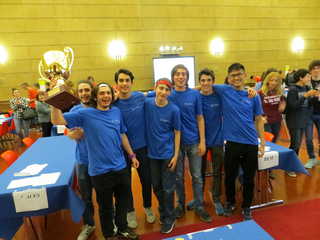
I spent many years in competitive swimming and studying piano, and along the way I’ve worked as a lifeguard, tutored, and taken part in academic competitions.
I’ve lived and studied abroad in China and Australia, with shorter periods in the UK, US, and France. I enjoy being somewhere unfamiliar and seeing how differently people live and think.
These days, a lot of my free time goes into building and tinkering with things: running a Debian home server, developing React websites, writing documentation in LaTeX, building Python software, and pretty much anything else that gives me an excuse to dig into how things work under the hood.
That curiosity extends well beyond technology. I spend a lot of time reading about finance, geopolitics, strategy games, and generally disappearing down whatever rabbit hole happens to catch my attention.
Rust · TypeScript · JavaScript · Python · C++
React · HTML/CSS
Node.js · Tauri · Vite
SQL
LaTeX
Agentic coding workflows, including coding agents, subagent orchestration, tool use and context design.
I work across production planning, manufacturing engineering, data analysis and digital OT, with a focus on analysing, digitalising and standardising production operations, projects and reporting.
As part of a broader effort to digitalise production operations, I design and develop end-to-end software applications, covering data architecture, databases, backend logic, system integration, user interfaces and deployment. My work includes:
Alongside software development, I work directly on production planning and manufacturing performance, managing priorities, lot allocation, sequencing and capacity while analysing OEE, scrap, cycle times, quality and production losses to support root-cause analysis, Lean Manufacturing and continuous improvement.
Specialisation in Engineering Application:
An application-oriented track focused on connecting materials science fundamentals with real engineering problems, from material selection and processing to performance, failure, surface engineering, energy applications, and sustainability.
The programme covered metals, polymers, composites, and advanced materials, combining their mechanical and chemical behaviour with characterisation methods, manufacturing considerations, corrosion, product development, and life-cycle assessment.
A selection of lecture notes from the programme is available here.
🎓 Master’s Thesis ➝ Solid-State Aluminium Recycling
Experimental investigation of solid-state aluminium recycling via roll bonding, analysing the influence of process parameters on microstructure, mechanical properties, and hardness to assess feasibility and material behaviour.
“World Wide Exchange Program” offered by Politecnico di Milano.
It focused on project-based learning and practical application of materials science concepts, with work spanning multiscale modelling, bio-functional and smart polymeric materials, thermodynamics, and advanced characterisation techniques.
A selection of projects completed during the exchange is available here.
The programme built a broad foundation in materials science and engineering, covering the behaviour, processing, and characterisation of metals, polymers, and ceramics, together with mechanics, corrosion, experimental methods, and CAD.
🧪 Bachelor’s Thesis ➝ Printed Device for Energy Storage (Group Project)
Development and characterisation of a printed energy-storage device, focusing on gel-based electrolytes to optimise energy density, ionic conductivity, and mechanical resistance for improved overall performance.